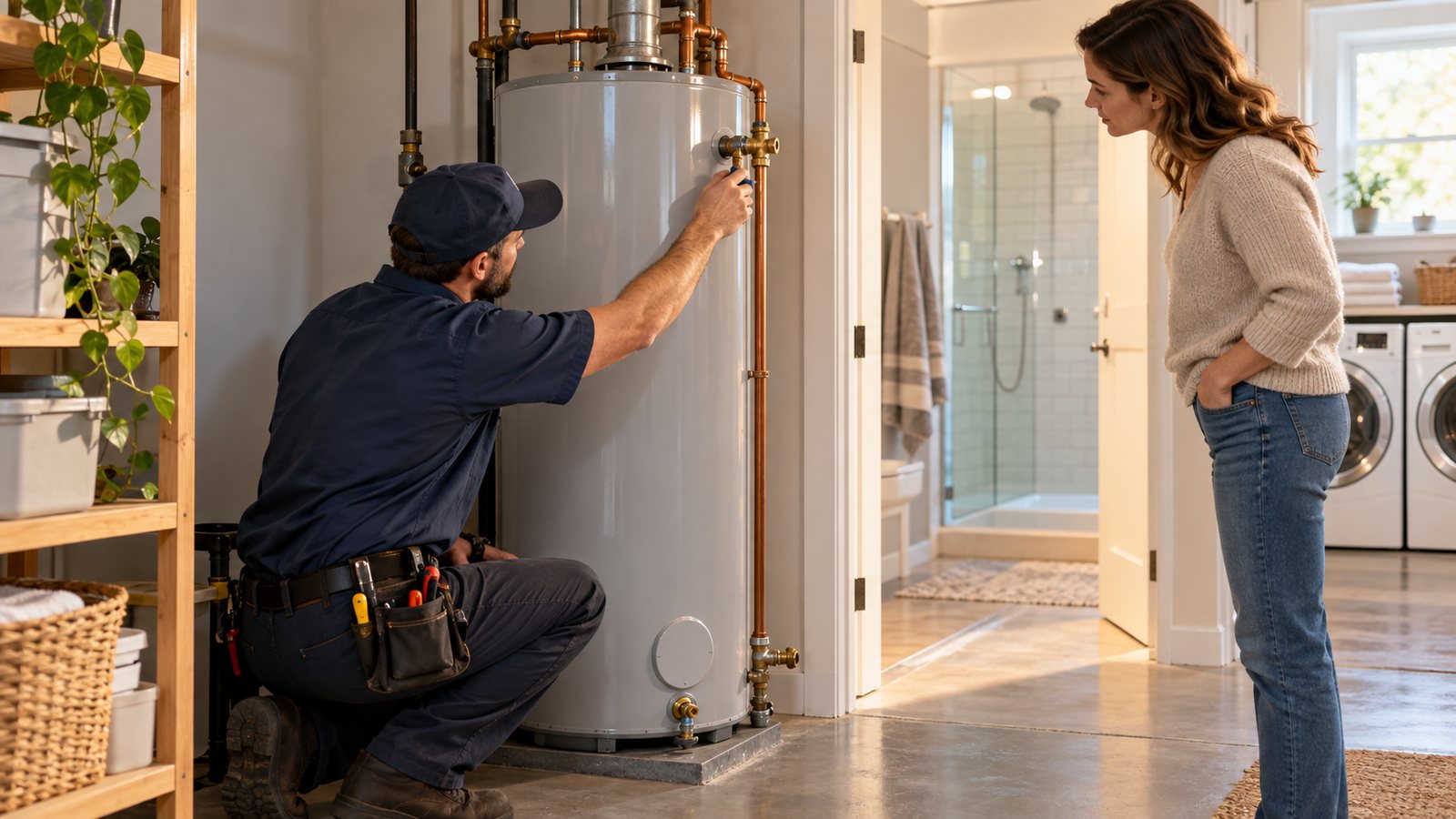
Quick answer: For a storage or heat-pump water heater, estimate the household's busiest hour of hot-water use and compare it with each model's first-hour rating (FHR). For tankless equipment, compare simultaneous hot-water flow with its rated output at the temperature rise needed in your climate. Household size or the old tank's gallon label alone cannot answer the question.
Capacity is a different decision from price. After narrowing suitable models, consult the water heater replacement cost guide to compare the complete installed scope, including venting, electrical work and permits.
Tank gallons and first-hour rating are different
A nominal 50-gallon storage tank holds water, but its one-hour delivery also depends on how quickly its burner, elements or heat pump replace heat as the tank is drawn down. ENERGY STAR defines FHR as the estimated maximum amount of hot water a storage unit can supply in one hour, starting with a fully heated tank. Compare the published FHR of the exact model, not only its tank volume, with the household's estimated peak-hour demand.
Two tanks of the same nominal volume may have different FHR values. A shower also mixes hot and cold water, so its total gallons are not automatically gallons drawn from the heater. Measure fixture flow and estimate the hot fraction rather than silently counting all mixed water as hot. Actual delivery varies with inlet temperature, thermostat setting and use pattern; a label is a standardized comparison rather than a promise for every household.
Make a peak-hour worksheet
Choose the busiest realistic continuous 60-minute window. Record showers, baths, sink use, dishwasher and laundry that genuinely occur within it. Estimate each event's hot-water gallons from fixture flow and duration or appliance data. Add them once. If the dishwasher normally runs after everyone leaves, do not include it simply to inflate the answer.
Repeat the worksheet for a usual morning and a plausible high-demand morning, perhaps when guests visit. This creates low, typical and high planning cases. The high case may suggest a higher FHR or a change in scheduling, but a rare event should not automatically dictate an oversized permanent system. Ask a contractor to show how each candidate model handles both cases.
| Demand case | Example pattern | What to test |
|---|---|---|
| Low | One shower and minor sink use. | Whether a smaller compliant model covers measured use. |
| Typical | Two showers plus ordinary kitchen use. | Published FHR against the summed hot gallons. |
| High | Back-to-back showers with laundry or a large bath. | A higher FHR, changed schedule or alternative technology. |
These are patterns, not universal tank-size recommendations. Fixture flow, recovery, inlet-water temperature and user behavior matter more than a generic chart by bedrooms.
Worked example: the morning rush
Suppose a hypothetical household measures two showers at 2 gallons per minute of mixed water for eight minutes each. Mixed water totals 2 × 8 × 2 = 32 gallons. Assume half the mix comes from the hot line solely for this example: 16 hot gallons. In the same hour, kitchen use draws 4 hot gallons and a washer cycle draws 8. The estimated peak is 16 + 4 + 8 = 28 hot gallons in one hour.
If a third matching shower occurs within that hour, add 8 hot gallons and the high case becomes 36. A hypothetical model rated for 38 gallons in the first hour may satisfy that numerical comparison, while one rated at 30 may cover the typical case but not the high case. These ratings and fixture values are arithmetic examples, not product claims. A real selection needs measured flow, appliance specifications, local inlet-water conditions and the exact model's label.
A worksheet cannot promise an uninterrupted shower. Timing, storage temperature, mixing and recovery affect experience. If the existing heater runs out, record when and after which uses. That evidence is more helpful to a contractor than saying only that four people live in the house.
Tankless units use a different sizing test
A tankless unit is judged primarily by simultaneous hot-side flow and temperature rise. Imagine two showers each requiring 1.5 gallons per minute from the hot line and a sink using 0.5 at the same time. Demand is 3.5 hot-side gallons per minute. If incoming water is 50°F in winter and the intended heater outlet is 120°F, the unit must provide a 70°F rise at that flow. Compare published model performance at that rise, not a maximum GPM advertised under warmer test conditions.
Those flows and temperatures are hypothetical. Cold inlet water varies with region and season; safe outlet settings and mixing devices require professional judgment. U.S. DOE Building Science Education describes maximum practical simultaneous flow and required temperature rise as the key tankless sizing inputs.
Heat-pump water heater considerations
A heat-pump water heater has a storage tank but may recover differently from a conventional gas or resistance-electric unit. Compare its FHR and available operating modes rather than assuming the same gallon label means identical delivery. ENERGY STAR advises providing the air volume, clearance and service access specified by the manufacturer. A condensate drain route is also needed, and cool exhaust air and compressor sound can affect where the unit belongs.
For a utility closet, ask if a louver, duct or new location is required and included. For a cold garage, check the model's operating limits and freeze protection. A different circuit, breaker or electrical service may change the project budget. A model with an adequate FHR may still be a poor choice if the installation cannot meet its instructions.
What belongs in a complete quote?
Request the exact model, tank volume or tankless flow rating, published FHR where relevant, fuel, efficiency label, venting, drain pan, condensate disposal, expansion control, seismic restraint where required, shutoffs, gas or electrical work, old-unit removal, disposal, permit, inspection, startup and warranty. A technology switch may need a separate utility assessment. Use the contractor quote comparison tool to align those items across bids.
Potential exclusions include concealed water damage, gas-line upgrades, panel work, chimney repair and interior finish restoration. Unknown work should have a written allowance and authorization rule. The project contingency calculator keeps that uncertainty separate from the fixed appliance price.
Local rules and safety
Plumbing, energy-code, permit and utility requirements differ across U.S. jurisdictions. A like-for-like replacement may have a different approval path from fuel conversion, relocation or a new circuit. Cold regions may need more temperature rise; some seismic zones require restraint; an attic or closet presents distinct drainage, venting or access needs. Confirm the local rule and the manufacturer's instructions before ordering a unit.
Hot water can scald. Discuss set point and anti-scald devices with a qualified installer. Do not simply raise temperature to make an undersized system appear adequate. If poor delivery began suddenly, diagnose a faulty component or mixing issue before replacing a sound tank. The repair versus replacement guide helps separate failure from capacity.
Questions for comparable bids
- Which peak-hour events and gallons did you assume?
- What is the exact model's FHR or flow at the relevant temperature rise?
- What winter inlet-water temperature did you use?
- Does the location meet air, clearance, venting and drainage requirements?
- What is fixed price, what is an allowance, and who approves changes?
- Who obtains the permit and documents startup?
If moisture near the heater prompted this project, use the hidden water-leak checklist to confirm the source before installation.
Frequently asked questions
Is a 50-gallon tank enough for four people?
Possibly, but household count alone is insufficient. Compare the exact model's FHR with measured busiest-hour demand.
Does a bigger tank always cure short showers?
No. A failed component, heavy overlap, poor recovery or mixing issue may cause the problem. Diagnose first.
What does first-hour rating measure?
It estimates hot-water volume delivered during one hour starting with a fully heated storage tank, including recovery under standardized conditions.
How do I size a tankless heater?
Add the hot-side flows that truly run together, then compare the model's output at the needed rise from local cold inlet water.
Can a heat-pump unit fit in a closet?
Only if the specific model's air, clearance, service and ducting requirements can be met. Confirm condensate routing too.
Primary sources
- ENERGY STAR — Water Heater Product Criteria
- U.S. DOE Building Science Education — Tankless Sizing
- ENERGY STAR — Heat Pump Water Heater Design Considerations
Detailed planning notes for What Size Water Heater Do I Need
The sections below expand this guide so you can move from a quick answer to a more complete homeowner planning process. They focus on measurements, scope, quote comparison and the questions that reduce expensive surprises.
Plumbing repair decisions should include risk, access and remaining life
Plumbing costs are affected by more than the price of a fixture or appliance. Access behind walls or floors, shutoff condition, drain or vent work, permits, disposal, code upgrades and water damage can change the final scope. A simple visible repair may be inexpensive, while a hidden leak or aging connection can require diagnostic work before the contractor can price the job confidently.
For repair-versus-replacement decisions, consider age, reliability, recurring service calls, efficiency, availability of parts and the consequences of another failure. Water heaters, toilets and supply components can have very different risk profiles. A lower-cost repair can make sense when the rest of the system is sound, while repeated failures may justify pricing replacement so you can compare the total expected cost instead of making one isolated decision.
Continue with our guides on detecting hidden water leaks and water-heater repair vs replacement. For independent information on water efficiency, see EPA WaterSense; for water-heating efficiency information, review the U.S. Department of Energy water-heating resources.
Measure twice before you order material
Quantity errors usually come from the inputs, not the formula. Recheck length, width, depth, pitch or surface area and make sure every measurement uses the same unit. For irregular projects, break the area into simple rectangles, triangles or other manageable shapes, calculate them separately, then add the results. This is usually more reliable than forcing a complicated space into one rough measurement.
After calculating the theoretical quantity, think about waste and purchase increments. Cuts, breakage, compaction, spillage, pattern matching and packaging can create a gap between calculated quantity and what you actually need to buy. The correct allowance depends on the material and project. Avoid adding a large arbitrary percentage “just in case”; instead, use supplier packaging, installation guidance and the shape of the project to choose a sensible buffer.
Finally, confirm the order with the supplier or installer when mistakes would be expensive. Ask how the product is sold, whether quantities are rounded, whether there is a minimum order and how returns are handled. Save your measurements and calculation so you can explain the order later and compare it with the contractor's takeoff.
A practical way to use this HomeCostEngine guide
Use this article in three passes. First, understand the cost or quantity drivers so you know what information matters. Second, run the related calculator with your own measurements instead of relying on a national average. Third, compare the result with local supplier prices or written contractor proposals. That sequence turns a general online guide into a project-specific planning tool.
Keep a simple project file with measurements, screenshots, product names, quotes and notes from contractor conversations. When a number changes, update the assumption instead of starting from scratch. This is especially useful when bids arrive weeks apart or when one proposal contains a different material, warranty or scope. A documented baseline helps you notice meaningful differences rather than being distracted by the final total alone.
Remember that HomeCostEngine estimates are for budgeting and education. They do not include every local code requirement, permit rule, hidden condition or labor-market difference, and they are not a substitute for a site inspection. For structural, electrical, plumbing, HVAC, roofing or other work where safety and code compliance matter, verify the final plan with qualified local professionals. If a contractor discovers hidden damage after work begins, ask for photos, an explanation and a written change order before approving additional work whenever practical.
Common mistakes that make online estimates less accurate
- Using living area instead of project area. Roof surface, paintable wall area, flooring area and landscape beds can all differ from the home's advertised square footage.
- Comparing incomplete scopes. Demolition, disposal, preparation, permits, delivery and accessories may be included in one quote and excluded from another.
- Ignoring purchase increments. Bags, cartons, bundles, truckloads and supplier minimums can force the real order above the theoretical calculation.
- Assuming one national price fits every location. Labor rates, access, codes, climate and material availability vary across U.S. markets.
- Choosing only on price. Product specification, workmanship, warranty, schedule and clarity of scope can be as important as the lowest total.
Before you approve the project
Recheck the final measurements and confirm who is responsible for permits, site protection, disposal and cleanup. Make sure important materials are identified by product or performance specification rather than a vague category. Review deposit and progress-payment terms, start and completion expectations, warranty language and the process for unexpected conditions. Keep copies of signed documents and receipts.
If the project is still in the research stage, use the related HomeCostEngine calculators and articles linked throughout this page to test more than one scenario. Changing the project size, material or labor assumption can show which inputs have the biggest effect on the budget. That is usually more useful than chasing one “perfect” average price from the internet.