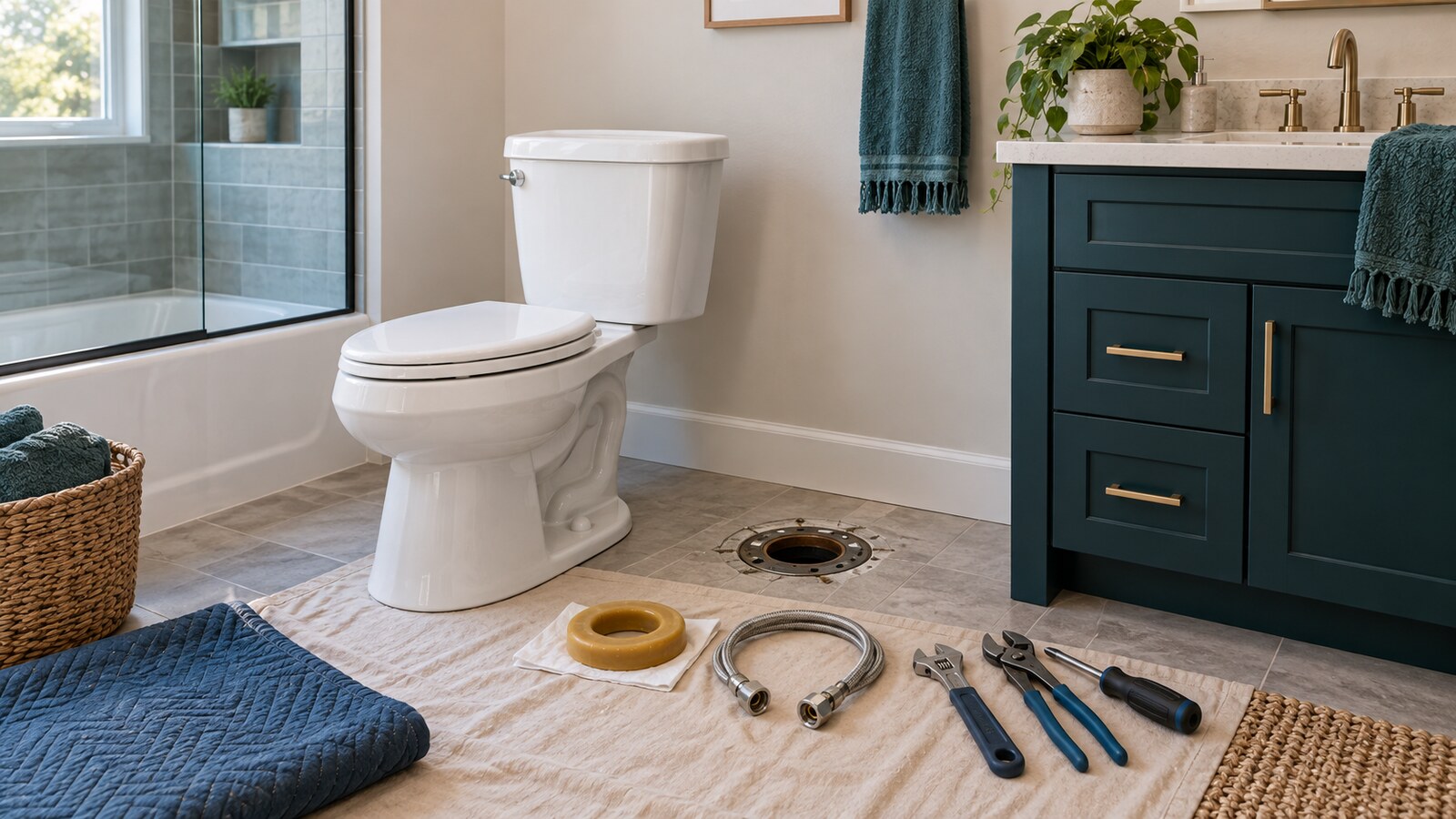
A toilet installation can be a straightforward fixture swap or a small plumbing and floor-repair project. The difference is often hidden until the old toilet is removed. A quoted price is meaningful only when it states who supplies the fixture, whether removal is included, which connection parts are being replaced, and what happens if the flange, shutoff valve or finished floor needs correction.
This guide does not publish a universal national price because labor rates, fixture choices, access, code administration and concealed conditions vary widely. Instead, it shows how to build low, typical and high scope scenarios and compare local written quotes on the same basis. Enter the prices you can verify in the free Toilet Installation Cost Calculator to keep known scope, repair allowances and contingency separate.
Plan by scope level, not one average price
Lower-complexity replacement
The existing toilet is removed and a compatible replacement is installed in the same location. The shutoff works, the supply connection is serviceable, the flange is secure at the correct height, the floor is sound, and the selected fixture matches the existing rough-in. Scope normally includes a new seal, mounting hardware, connection, testing and cleanup. Confirm disposal rather than assuming it.
Typical replacement with minor corrections
The toilet stays in the same location, but the project may also need a new supply line, shutoff-valve service, minor flange correction, caulk, seat installation or limited adjustment for an uneven finished floor. The quote should distinguish included work from allowances that can change after removal.
Higher-complexity installation
The drain location changes, the rough-in is nonstandard, the flange or subfloor is damaged, the fixture is wall-hung or otherwise specialized, access is difficult, or the work is part of a larger remodel. Floor repair, drain or vent changes, wall opening, electrical work for a bidet seat, inspections and finish restoration can involve additional trades.
These are scope bands, not price promises. Use the Bathroom Remodel Cost Calculator when the toilet is one component of a wider renovation rather than an isolated replacement.
What belongs in a complete toilet installation quote?
- Fixture and seat: exact model, bowl height, shape, flush type, color and any allowance.
- Delivery and handling: who receives the fixture and who is responsible for transit damage or a defective unit.
- Removal and disposal: old-fixture disconnection, haul-away and disposal charges.
- Connection materials: seal, mounting hardware, supply line and any planned shutoff-valve work.
- Flange assumptions: what basic installation includes and how repair, replacement or height correction will be priced.
- Floor and finish work: leveling, damaged flooring, subfloor repair, caulk and restoration around a different footprint.
- Testing and cleanup: leak checks, flushing, stability check and removal of packaging.
- Permit and inspection responsibility: when required by the local authority or larger project scope.
Run competing proposals through the Contractor Quote Comparison Tool. A lower total may exclude disposal or flange work that another plumber has identified explicitly.
The rough-in and fixture footprint matter
The rough-in is commonly measured from the finished wall—not the baseboard—to the center of the closet bolts or drain connection, depending on the situation. Do not order solely from a casual tape measurement. Wall finishes, baseboards, offset flanges and prior alterations can confuse the measurement. Have the installer confirm compatibility with the exact fixture specification.
A replacement toilet can also expose an outline in the flooring if the new base has a smaller footprint. This may be cosmetic, or it may require finish repair. In a tight bathroom, verify door swing, vanity clearance and usable space around the bowl before selecting an elongated or differently shaped model.
Hidden conditions that change the scope
Flange damage or incorrect height
The closet flange anchors the toilet and connects it to the drain system. Corrosion, cracks, loose fasteners, improper height or previous improvised repairs can prevent a stable seal. Ask the quote to state whether simple correction is included and how more extensive repair will be authorized.
Subfloor or finish damage
Long-term leakage can soften subflooring or stain and delaminate finishes. The visible toilet may feel stable even when the material below has deteriorated. A plumber may need another trade to repair structural or finish layers before final installation.
Shutoff valve and supply connection
A valve that does not close fully, a corroded connection or an aging supply line can add work. Replacement decisions should be based on condition and compatibility rather than automatically reusing an uncertain connection.
Active or unexplained leakage
A puddle near a toilet can come from the tank, supply, condensation, mounting seal or another nearby source. If the source is unclear, follow a systematic check such as the hidden water-leak detection guide before treating fixture replacement as the diagnosis.
Worked example: normalize two local quotes
Assume a homeowner receives two hypothetical proposals for a like-for-like floor-mounted replacement. Quote A is $640 and includes a $260 fixture allowance, removal, disposal, seal, supply line, installation and testing. It excludes flange repair. Quote B is $575 but the homeowner supplies the fixture separately for $240, disposal is $55, and a supply line is $20.
Normalize the known scope before comparing:
- Quote A known total: $640.
- Quote B comparable known total: $575 + $240 + $55 + $20 = $890.
The exercise does not prove that Quote A is the better contractor, and it does not price concealed damage. It shows why a headline labor number cannot be compared with an all-in proposal. The homeowner should confirm licensing or registration rules, insurance, warranty, scheduling and the change-order method before deciding.
Build a reserve for uncertain conditions
A basic replacement quote can reasonably exclude damage that cannot be seen until removal. Keep that uncertainty separate from the known price. For example, a homeowner might list the confirmed fixture and installation scope as the base budget, then create a distinct reserve for possible flange, valve or floor work. The Project Contingency Calculator helps show the reserve separately rather than hiding it inside an unsupported total.
Do not authorize open-ended repairs without documentation. Ask the installer to stop, photograph the condition, explain the proposed correction and obtain written approval when the discovered work exceeds the agreed scope.
Repair may be more appropriate than replacement
A running toilet, weak flush or slow refill does not automatically require a new fixture. A sound toilet may only need a flapper, fill valve, handle, supply connection or other service part. Cracked porcelain, an unstable fixture, repeated clogging, recurring seal problems or multiple failures can change the decision. Use the toilet repair-versus-replacement framework before paying for a full installation that does not address the true problem.
Efficiency and product selection
If replacement is justified, compare independently certified performance as well as water use. The U.S. Environmental Protection Agency explains that WaterSense-labeled tank-type toilets must meet program efficiency and performance criteria through third-party certification. Product fit, bowl height, seat, flush performance, replacement parts and warranty are still important purchase questions.
Utilities sometimes offer rebates or vouchers, but availability and eligibility are local. Verify the current program before purchase and confirm whether a specific model number is required.
Permits, inspections and regional differences
Permit rules vary by city, county and state. A direct fixture replacement may be treated differently from moving the drain, altering venting, replacing concealed piping, adding an electrical outlet or completing a permitted bathroom remodel. Contact the local building department for the adopted rules and ask who will obtain any required permit and schedule inspections.
Regional conditions can also change the work. Older housing may have nonstandard previous alterations; slab-on-grade construction can make drain relocation more disruptive; multifamily buildings may require shutoff coordination or building approval; and condominium associations may impose contractor, insurance or working-hour requirements. These conditions belong in the scope before work begins.
What is usually excluded unless stated?
- Repair of concealed rot, mold-related conditions or damaged subfloor.
- Relocation of the drain, water line or vent.
- Tile, resilient flooring, baseboard, drywall or paint restoration.
- Electrical work for powered seats or nearby receptacles.
- Structural alteration or accessibility redesign.
- Permit fees, building deposits or after-hours coordination.
- Correction of unrelated plumbing defects discovered during the visit.
For a broader project, the Bathroom Remodel Cost Guide explains waterproofing, plumbing, ventilation, finishes and quote scope beyond the toilet itself.
Homeowner checklist before installation day
- Confirm the exact model, rough-in compatibility and fixture dimensions.
- Agree on who purchases, delivers and inspects the fixture.
- Verify removal, disposal, seat, seal, supply line and shutoff assumptions.
- Clear access and follow building rules for parking, elevators or water shutoff.
- Ask how concealed flange or floor damage will be documented and approved.
- Keep the model information, receipt, warranty and installer invoice.
- After installation, check stability, flush operation and visible connections, then continue observing for moisture.
Frequently asked questions
What should a toilet installation quote include?
A clear quote should identify the fixture or allowance, removal and disposal, seal, supply connection, mounting, testing, cleanup, permit responsibility and how flange or floor damage will be handled.
Does replacing a toilet require a permit?
Requirements vary by jurisdiction and scope. A like-for-like replacement may be treated differently from relocating a drain, changing plumbing or completing a permitted bathroom remodel. Confirm with the local building department.
Why can a simple replacement become more expensive?
A damaged flange, corroded shutoff, leaking supply, uneven floor, concealed moisture damage, nonstandard rough-in or access constraints can add work beyond the basic fixture swap.
Should I repair or replace a running toilet?
A sound fixture with a failed flapper, fill valve or handle may only need repair. Replacement is a different decision when porcelain is cracked, mounting is unstable, recurring problems persist or a broader remodel is underway.
Sources and further reading
Detailed planning notes for Toilet Installation Cost
The sections below expand this guide so you can move from a quick answer to a more complete homeowner planning process. They focus on measurements, scope, quote comparison and the questions that reduce expensive surprises.
Plumbing repair decisions should include risk, access and remaining life
Plumbing costs are affected by more than the price of a fixture or appliance. Access behind walls or floors, shutoff condition, drain or vent work, permits, disposal, code upgrades and water damage can change the final scope. A simple visible repair may be inexpensive, while a hidden leak or aging connection can require diagnostic work before the contractor can price the job confidently.
For repair-versus-replacement decisions, consider age, reliability, recurring service calls, efficiency, availability of parts and the consequences of another failure. Water heaters, toilets and supply components can have very different risk profiles. A lower-cost repair can make sense when the rest of the system is sound, while repeated failures may justify pricing replacement so you can compare the total expected cost instead of making one isolated decision.
Continue with our guides on detecting hidden water leaks and water-heater repair vs replacement. For independent information on water efficiency, see EPA WaterSense; for water-heating efficiency information, review the U.S. Department of Energy water-heating resources.
How to turn a cost estimate into a useful budget
Start by separating quantity from price. Quantity answers “how much work or material is involved,” while price answers “what does that amount cost in this market with this scope.” Keeping those two ideas separate makes it easier to understand why contractor quotes differ. If one bid is much higher, look first for a scope difference: better materials, more demolition, difficult access, additional preparation, permit work, longer warranty, cleanup or repairs that another proposal omitted.
Use a range instead of one precise number. Early project estimates contain uncertainty, so a low-to-high planning range is more useful than pretending the project will cost exactly one amount. As you collect local quotes and confirm measurements, narrow the range. Keep a contingency for unknown conditions when the project can expose hidden damage or when site conditions are not fully visible before work starts.
Before signing, compare the payment schedule, exclusions, change-order process, product specifications, warranty responsibilities and cleanup requirements. A quote that is clear about what is not included can be easier to manage than a cheaper quote with vague language. The goal of the estimate is not to pick the lowest number automatically; it is to help you ask better questions and recognize when two proposals are not actually pricing the same job.
A practical way to use this HomeCostEngine guide
Use this article in three passes. First, understand the cost or quantity drivers so you know what information matters. Second, run the related calculator with your own measurements instead of relying on a national average. Third, compare the result with local supplier prices or written contractor proposals. That sequence turns a general online guide into a project-specific planning tool.
Keep a simple project file with measurements, screenshots, product names, quotes and notes from contractor conversations. When a number changes, update the assumption instead of starting from scratch. This is especially useful when bids arrive weeks apart or when one proposal contains a different material, warranty or scope. A documented baseline helps you notice meaningful differences rather than being distracted by the final total alone.
Remember that HomeCostEngine estimates are for budgeting and education. They do not include every local code requirement, permit rule, hidden condition or labor-market difference, and they are not a substitute for a site inspection. For structural, electrical, plumbing, HVAC, roofing or other work where safety and code compliance matter, verify the final plan with qualified local professionals. If a contractor discovers hidden damage after work begins, ask for photos, an explanation and a written change order before approving additional work whenever practical.
Common mistakes that make online estimates less accurate
- Using living area instead of project area. Roof surface, paintable wall area, flooring area and landscape beds can all differ from the home's advertised square footage.
- Comparing incomplete scopes. Demolition, disposal, preparation, permits, delivery and accessories may be included in one quote and excluded from another.
- Ignoring purchase increments. Bags, cartons, bundles, truckloads and supplier minimums can force the real order above the theoretical calculation.
- Assuming one national price fits every location. Labor rates, access, codes, climate and material availability vary across U.S. markets.
- Choosing only on price. Product specification, workmanship, warranty, schedule and clarity of scope can be as important as the lowest total.
Before you approve the project
Recheck the final measurements and confirm who is responsible for permits, site protection, disposal and cleanup. Make sure important materials are identified by product or performance specification rather than a vague category. Review deposit and progress-payment terms, start and completion expectations, warranty language and the process for unexpected conditions. Keep copies of signed documents and receipts.
If the project is still in the research stage, use the related HomeCostEngine calculators and articles linked throughout this page to test more than one scenario. Changing the project size, material or labor assumption can show which inputs have the biggest effect on the budget. That is usually more useful than chasing one “perfect” average price from the internet.